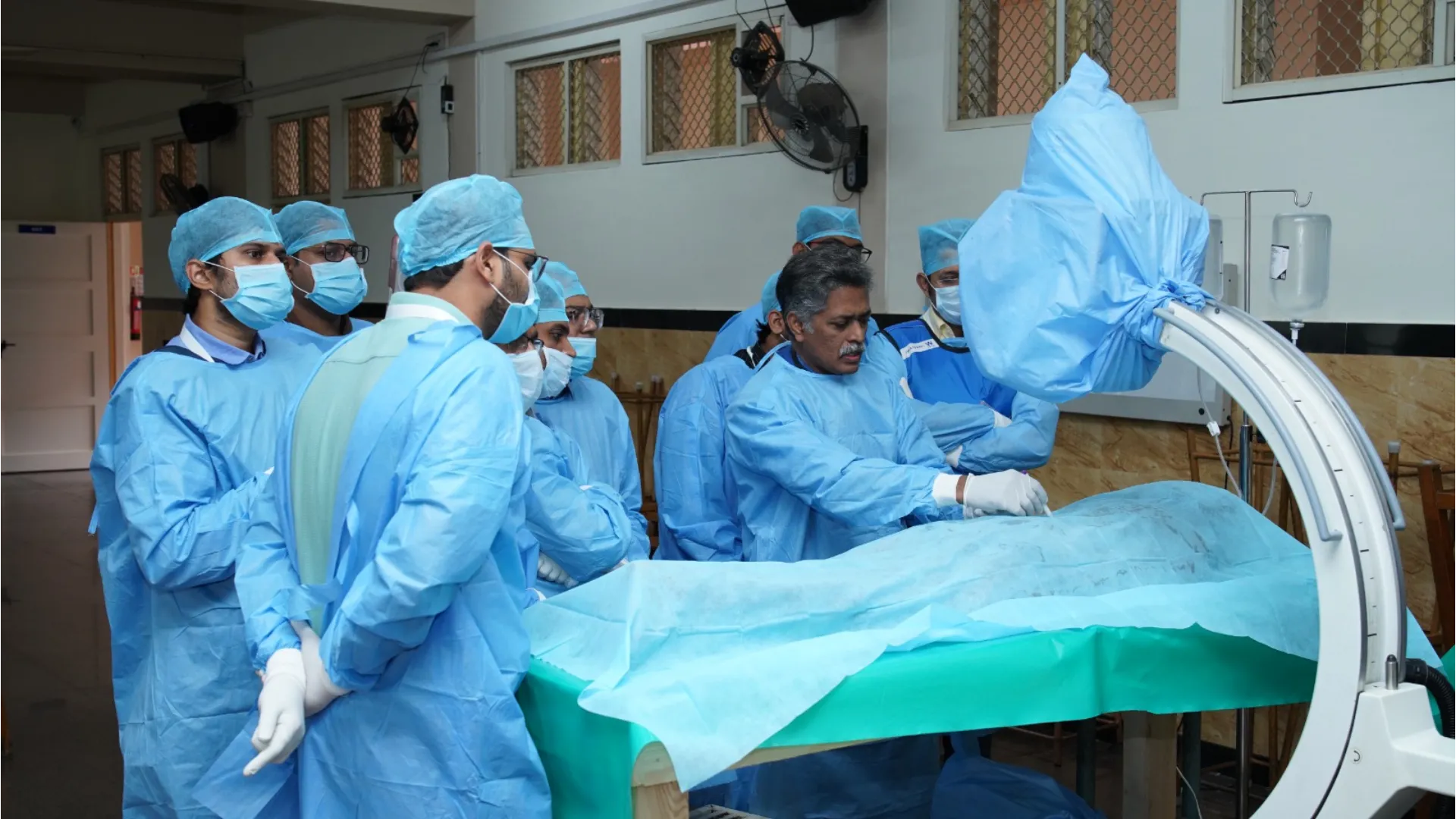
Spine Endoscopic Cadaveric Workshop

  • Home
  • Spine Endoscopic Cadaveric Workshop

Spine Endoscopic Cadaveric Workshop


Course Image
Course Overview

The GSI Spine Endoscopic Cadaveric Workshop is a focused, one-day, hands-on training program designed to equip practising spine surgeons with advanced skills in minimally invasive and full-endoscopic spine surgery. Conducted on cadaveric specimens under expert faculty guidance, the curriculum focuses on Percutaneous Endoscopic Lumbar Discectomy (PELD) and interlaminar endoscopic spine surgery, two of the most innovative and rapidly evolving techniques in modern spinal care.

Participants gain practical experience in performing spinal nerve decompression through the natural intervertebral foramen and the interlaminar corridor using minimally invasive techniques. The program emphasises procedures performed through incisions as small as 8 mm, minimising muscle disruption, bone removal, blood loss, and postoperative recovery time. The workshop also highlights the clinical advantages of PELD, including its ability to be performed under local anaesthesia with reduced complications and faster patient recovery.

At the Global Surgical Institute's Cadaveric Workshop, expert mentors guide participants through transforaminal and interlaminar endoscopic approaches using focused lectures, case-based discussions, and extensive supervised cadaveric dissection. With limited participant intake and personalised mentorship, the program is designed to enhance surgical confidence, refine endoscopic techniques, and translate cadaveric training into safe, effective operative practice.

Learning Objectives
  • Build proficiency in interlaminar and transforaminal endoscopic spine surgery on cadaveric specimens.
  • Identify key surgical landmarks for safe and accurate endoscopic navigation.
  • Apply patient-specific decision-making for selecting the appropriate endoscopic approach.
  • Master endoscopic instrumentation and techniques that minimise tissue and posterior element disruption.
  • Develop confidence in performing PELD and related keyhole spine procedures.
Learning Methodology
  • Focused theoretical sessions covering endoscopic spine anatomy and technique.
  • Step-by-step demonstrations of each procedure by expert faculty before participant practice.
  • Extensive hands-on cadaveric dissection for interlaminar and transforaminal approaches.
  • Case-based discussions on indications, pitfalls, and complication management.
  • Continuous feedback and personalised mentoring to refine surgical technique and build confidence.
Learning Outcomes
  • Understand the principles, indications, and evolution of endoscopic spine surgery from open to minimally invasive approaches.
  • Demonstrate keyhole entry and muscle-sparing techniques for the interlaminar and transforaminal corridors.
  • Correctly identify the anatomy of the interlaminar space and surrounding neural structures.
  • Operate endoscopic equipment and instrumentation with confidence and precision.
  • Be equipped to translate cadaveric experience into safe, independent operative practice.
Eligibility Criteria
  • Spine Surgeons
  • Orthopaedic Surgeons
  • Neurosurgeons with an interest in endoscopic spine techniques
Course Modules
Module 1: Foundations of Endoscopic Spine Surgery — Principles, Evolution, and Indications for Endoscopic versus Open Spine Surgery
Module 2: Applied Endoscopic Anatomy of the Interlaminar Space, Neural Foramen, and Surrounding Neurovascular Structures
Module 3: Interlaminar Endoscopic Approach — Keyhole Entry, Muscle-Sparing Dissection, and Posterior Decompression
Module 4: Percutaneous Endoscopic Lumbar Discectomy (PELD) — Transforaminal Access and Nerve Root Decompression
Module 5: Cadaveric Hands-On Dissection with One-on-One Faculty Supervision
Module 6: Case Discussions and Complication Management in Endoscopic Spine Surgery
Course Duration
  • Duration: 1 Day (Offline / In-Person format)

WhatsApp